
When you hear the word scoliosis, you might imagine teenagers wearing back braces. But here’s something you may not know: scoliosis isn’t just a condition for the young. It’s a reality for millions of adults, too. In fact, adult scoliosis has received growing attention in research over the past two decades. More people are seeking to understand and manage this condition.
Scoliosis Isn’t Just a Teen Problem
Scoliosis affects more than 8% of adults over the age of 25. For some, it’s a continuation of a curve that began during adolescence. For others, it develops later in life due to changes in the spine. Scoliosis in adults is more common than many people realize regardless of when it starts. In fact, some studies estimate that as many as 38% of adults over 40 may have some degree of scoliosis, especially women over the age of 60.
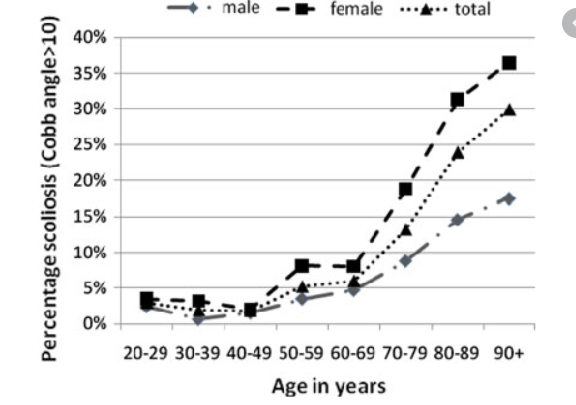
Figure: Prevalence of scoliosis (Cobb angle >10°) by age and gender, showing a significant increase in scoliosis prevalence with age, particularly among females (Kilshaw et al., 2010).
Identifying Your Adult Scoliosis Type:
There are two main types of adult scoliosis:
- Adult Idiopathic Scoliosis
This is scoliosis that begins during adolescence and continues into adulthood. If you were diagnosed with scoliosis as a teen, your curve may have persisted—or may progress slowly into adulthood. - Adult Degenerative Scoliosis
This type develops later in life, often as a result of changes in the spine. Factors like arthritis, disc degeneration, and spinal instability can lead to a sideways curvature.

Myth Busted: Scoliosis Doesn’t Stop Progressing in Adulthood
Here’s a common misconception: “Once you’re an adult or you have reached bone maturity, your scoliosis won’t get worse.” Unfortunately, that’s not always the case. While progression tends to be much slower in adults compared to adolescents, it can still happen.
The risk of progression in adults depends largely on the size of your spinal curve:
| Angle Range | Risk Level |
|---|---|
| <30° | Low Risk |
| 30°–50° | Medium Risk |
| >50° | High Risk |
On average, adult scoliosis progresses at a rate of 1–3 degrees per year. Nonetheless, certain factors can speed things up, including:
- Advanced spinal degeneration
- Spinal instability
- Low bone density (osteoporosis)
Why Should You Care About Adult Scoliosis?
You might be thinking, “Okay, but does a curved spine really affect my life?” The answer is: it can. Some people with adult scoliosis experience no symptoms. Still, others deal with chronic pain and stiffness. They may also face nerve-related issues like numbness or tingling. In severe cases, the curvature can impact posture, balance, and even breathing. For those considering pregnancy, understanding how scoliosis may influence back pain, mobility, and delivery is important.
The good news? Understanding your condition is the first step toward managing it. Whether you’re dealing with mild discomfort or more significant challenges, there are ways to stay ahead of the curve.
Back Pain and Scoliosis in Adults: Are They Connected?
If you experience chronic or recurrent back pain, it’s important to find out whether scoliosis is a factor. In some cases, general treatments like pain relievers, massage, or physiotherapy might not fully address the root cause. This is particularly true if an underlying scoliosis exists.
Symptoms and Clinical Presentation in Adult Scoliosis:
1. Pain and Activity Limitation:
- Chronic pain: 61% of adults with scoliosis curves greater than 50 degrees report significant and persistent pain.
- Reduced activity levels: Adults with scoliosis often experience diminished activity levels compared to their peers. This makes it harder for them to stay active and engaged in daily life.
- Higher arthritis incidence: Degenerative changes in the spine can lead to a higher rate of self-reported arthritis. These changes also cause difficulty in performing physical activities.
2. Pulmonary Function Impairment:
- Thoracic curves (those in the rib cage area) can restrict lung capacity, particularly in severe cases. This may lead to reduced pulmonary function, making it harder to breathe deeply or engage in strenuous activities.
3. Visible and Functional Limitations:
- While visible curvature may be present, many adults report pain and functional impairments as their primary concerns.
- Common symptoms include radiculopathy (nerve pain), reduced mobility, and chronic back pain, often caused by degenerative changes in the spine.
The Latest in Treatment Options for Adult Scoliosis:
Exciting advancements in adult scoliosis treatment offer more options than ever before:
1. Bracing + Specialized Exercise Programs:
- Bracing isn’t just for teenagers anymore. Research shows that adults also benefit from adult bracing, especially when paired with scoliosis-specific exercises (Negrini et al., 2018).
- These programs are designed to manage pain, slow curve progression, and improve strength and flexibility.
2. Surgery:
- For severe cases, surgery may be necessary.
Whether through bracing, exercise, or surgery, these innovations focus on preserving mobility, reducing pain, and improving quality of life.
Vitamin D and Scoliosis Progression:
Vitamin D is crucial for bone strength and spinal health. Research shows that supplementing with Vitamin D and calcium reduces scoliosis progression.
What’s Next for Adult Scoliosis?
The future of adult scoliosis treatment looks encouraging and hopeful, with ongoing research focused on developing more effective solutions and understanding its underlying causes. Here’s what’s on the horizon:
- Genetics and Personalized Treatments:
Scientists are exploring the role genetics play in scoliosis, which could lead to tailored therapies based on your unique genetic makeup - Better Non-Surgical Therapies and Advancement in Surgical Options:
From improved brace designs to innovative therapeutic exercise techniques, treatment options are evolving rapidly. Advanced surgical developments are emerging. These advancements provide patients with greater control over their condition.
The Bottom Line
Adult scoliosis is a complex condition, but it doesn’t have to define your life. With a growing understanding of the condition and exciting advancements in treatment, there’s never been a better time to take control of your spinal health. Whether you’re exploring non-surgical options or considering surgery, the goal is the same: to reduce pain, improve mobility, and enhance your quality of life.
If you suspect you have scoliosis or are already managing the condition, don’t hesitate to reach out to a scoliosis clinician and therapist. Together, you can create a plan that works for you—and step confidently into a future with fewer limitations and more possibilities.
References:
- Palazzo, C., Montigny, J. P., Barbot, F., Bussel, B., Vaugier, I., Fort, D., Courtois, I., & Marty-Poumarat, C. (2017). Effects of Bracing in Adults With Scoliosis: A Retrospective Study. Archives of Physical Medicine and Rehabilitation, 98(1), 187-190. DOI: 10.1016/j.apmr.2016.05.019.
- Zaina, F., Poggio, M., Donzelli, S., & Negrini, S. (2018). Can bracing help adults with chronic back pain and scoliosis? Short-term results from a pilot study. Prosthetics and Orthotics International, 42(4), 410-414. DOI: 10.1177/0309364618757769.
- Kilshaw, M., Baker, R., Gardner, R., Charosky, S., & Harding, I. (2010). Abnormalities of the lumbar spine in the coronal plane on plain abdominal radiographs. European Spine Journal, 20, 429-433. DOI: 10.1007/s00586-010-1610-8.
- Negrini, S., Donzelli, S., Aulisa, A. G., Czaprowski, D., Schreiber, S., de Mauroy, J. C., Diers, H., Grivas, T. B., Knott, P., Kotwicki, T., Lebel, A., Marti, C., Maruyama, T., O’Brien, J., Price, N., Parent, E., Rigo, M., Romano, M., Stikeleather, L., Wynne, J., & Zaina, F. (2018). 2016 SOSORT guidelines: Orthopaedic and rehabilitation treatment of idiopathic scoliosis during growth. Scoliosis and Spinal Disorders, 13(3). https://doi.org/10.1186/s13013-017-0145-8
- McAviney, J., Roberts, C., Sullivan, B., & Graham, P. L. (2020). The prevalence of adult de novo scoliosis: A systematic review and meta-analysis. European Spine Journal, 29(12), 2960–2969. https://doi.org/10.1007/s00586-020-06453-0


 Ask Dr. James