
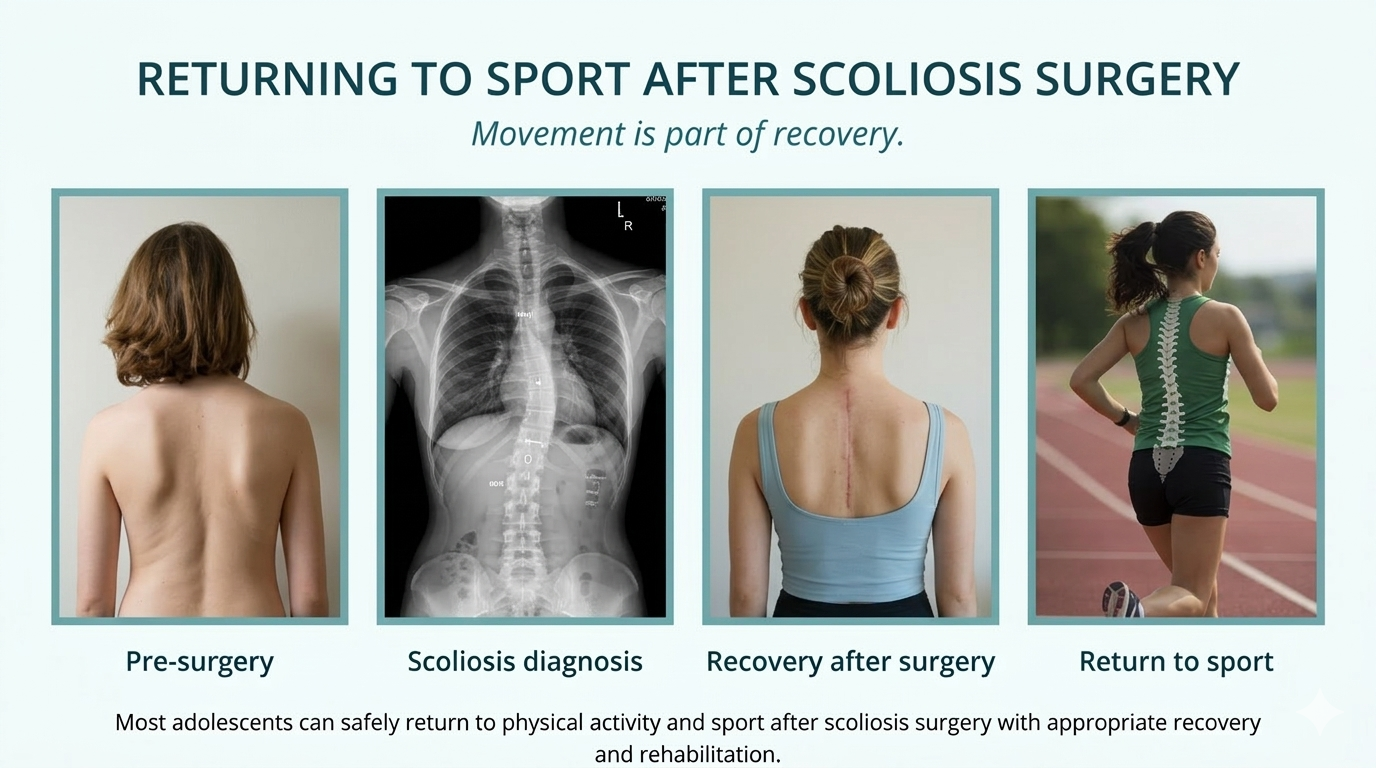
For adolescents undergoing scoliosis surgery, one of the most common and important questions is:
“Will I be able to return to the sport I love?” In the past, surgeons often recommended very cautious approaches to activity after surgery. Many patients were advised to avoid sports for extended periods, sometimes permanently restricting certain activities.1
Today, research and clinical experience tell a very different story.
Modern evidence shows that returning to physical activity is not only possible after scoliosis surgery — it is an essential part of the recovery process. With appropriate healing time and gradual progression, most adolescents can return to sports safely and successfully.
Why Staying Active Matters After Scoliosis Surgery
Adolescence is a critical time for physical development. Regular participation in sport helps build strength, coordination, cardiovascular fitness, and long-term musculoskeletal health — all of which are closely linked to maintaining good posture over time.2
For adolescents who undergo spinal surgery, remaining physically active is particularly important. Research suggests that individuals who stop engaging in sports after surgery may face a greater risk of long-term pain, stiffness, and reduced physical function in adulthood. 3
Despite this, studies show that 30–40% of patients never return to their previous level of physical activity after scoliosis surgery.4
In many cases, this is not because of physical limitations. Instead, the barriers are often psychological or informational, including:
- Fear of damaging the surgical hardware
- Anxiety from parents about potential injury
- Uncertainty about what activities are safe
- Overly conservative recommendations from healthcare providers
One of the major goals in modern scoliosis rehabilitation is to help patients overcome these fears and regain confidence in movement.
A spine that has been surgically corrected can still function, move, and support an active lifestyle.
Common Surgical Techniques for Scoliosis
Understanding the type of surgery performed can help patients and families understand what recovery may look like.
Spinal Fusion (Arthrodesis)
Spinal fusion remains the most common surgical treatment for adolescent idiopathic scoliosis.1
During this procedure, surgeons correct the spinal curvature using rods and screws while allowing certain vertebrae to fuse together. Although this stabilizes the spine and reduces motion in the fused segments, most patients are still able to perform a wide range of physical activities after recovery.5
In fact, many adolescents who undergo spinal fusion eventually return to competitive sports.
Vertebral Body Tethering (VBT)
Vertebral Body Tethering is a more recent surgical option designed to preserve spinal motion. Instead of permanently fusing the vertebrae, surgeons place a flexible cord along the curve to guide spinal growth and gradually correct the deformity.
Early research suggests that adolescents undergoing VBT may return to sports slightly earlier than those who undergo spinal fusion.
However, these patients are often highly active individuals before surgery, which can also influence recovery timelines.
Regardless of the surgical technique, movement and rehabilitation remain essential components of recovery.
When Can Adolescents Return to Sport?
Every patient heals at a different pace, and return-to-sport timelines should always be individualized. However, guidelines from the Scoliosis Research Society (SRS) provide a useful framework for recovery.2
These recommendations are based on the time needed for tissues to heal and for surgical implants to stabilize.
First 3 Months After Surgery
During the early recovery period, the focus is on gentle movement and rebuilding basic physical capacity.
Patients may begin light activities such as:
- Swimming
- Stationary cycling
- Light jogging
- Walking programs
- Gentle mobility and strengthening exercises
These activities help restore coordination, endurance, and confidence in movement without placing excessive stress on the healing spine.1
Around 6 Months After Surgery
If recovery is progressing well, many adolescents can begin returning to more dynamic sports, including:
- Soccer
- Basketball
- Tennis
- Volleyball
At this stage, athletes typically avoid direct physical contact or high-impact collisions while gradually increasing intensity, speed, and duration of activity. This phase is important for rebuilding athletic performance and conditioning.2
9–12 Months After Surgery
By this stage, many patients have achieved solid spinal healing and stability. With surgeon clearance, adolescents may return to higher-impact or contact sports, such as:
- Rugby
- Martial arts
- Hockey
- Gymnastics
Collision sports carry a low complication risk (<2%) post-12 months but require individualized assessment. Lenke curve type influences timelines, with less complex curves allowing faster returns.1
These timelines are guidelines rather than strict rules, and decisions should always be made collaboratively between surgeons, physiotherapists, patients, and families.
Is It Safe to Play Sports After Spinal Surgery?
One of the biggest concerns among parents is the possibility that sports could damage the rods, screws, or spinal cord. Similar concerns also exist for adolescents with scoliosis who have not had surgery, especially around high-impact activities.
Fortunately, research shows that serious complications related to sports participation are extremely rare.1
When issues do occur, they most often involve:
- Minor hardware irritation
- Loosening of a screw
- Rare cases of rod damage
These problems are usually associated with returning to high-risk activities too early, before adequate healing has occurred.
By following recommended timelines and progressing gradually, the risk of complications remains very low.
Suitable Sports Post-Surgery
Selecting appropriate sports after scoliosis surgery prioritizes low-impact activities initially, progressing to higher-intensity options as healing advances. Guidelines emphasize spinal stability, avoiding excessive rotation, hyperextension, or axial loading during early recovery.1
Sport as a Key Part of Rehabilitation
The goal of scoliosis surgery is not only to correct the spinal curve but also to help adolescents return to full participation in life.
Rehabilitation programs often involve collaboration between:
- Orthopedic surgeons
- Physiotherapists
- Exercise specialists
- Scoliosis rehabilitation providers
Together, these professionals guide patients through a gradual return to activity that prioritizes strength, flexibility, balance, and confidence.
For many adolescents, returning to sports marks a significant milestone in their recovery — not just physically, but also psychologically.
Life After Spinal Surgery
Ultimately, the question is no longer whether adolescents can return to sport after scoliosis surgery.
The real question is how and when to return safely.
Movement plays a powerful role in maintaining spinal health, improving physical function, and supporting long-term well-being.
For young patients recovering from scoliosis surgery, returning to sport is not a risk to avoid — it is often the final step toward regaining a full and active life.
References:
- Tetreault TA, Garg S. (2023). Return to play following spine surgery. Frontiers in Pediatrics, 11, 1176563.
https://doi.org/10.3389/fped.2023.1176563 - Tucker S, Heneghan NR, Rushton A, Gardner A, Russell E, Soundy A. (2026). International consensus on sports, exercise, and physical activity participation during post-operative interventions for adolescent idiopathic scoliosis: An e-Delphi study. PLOS ONE.
https://doi.org/10.1371/journal.pone.0322346 - Kakar RS, Simpson KJ, Das BM, Brown CN. (2017). Review of physical activity benefits and potential considerations for individuals with surgical fusion of the spine for scoliosis. International Journal of Exercise Science, 10(2), 166–177.
- Fabricant PD, Admoni S, Green DW, Ipp LS, Widmann RF. (2012). Return to athletic activity after posterior spinal fusion for adolescent idiopathic scoliosis: Analysis of independent predictors. Journal of Pediatric Orthopaedics, 32(3), 259–265.
https://doi.org/10.1097/BPO.0b013e31824b285f - Baroncini, A., Trobisch, P. D., Berrer, A., Kobbe, P., Tingart, M., Eschweiler, J., Da Paz, S., & Migliorini, F. (2021). Return to sport and daily life activities after vertebral body tethering for AIS: Analysis of the sport activity questionnaire. European Spine Journal, 30(7), 1998–2006.
https://doi.org/10.1007/s00586-021-06768-6


 Ask Dr. James